How to Play Chess: A Complete Beginner's Guide
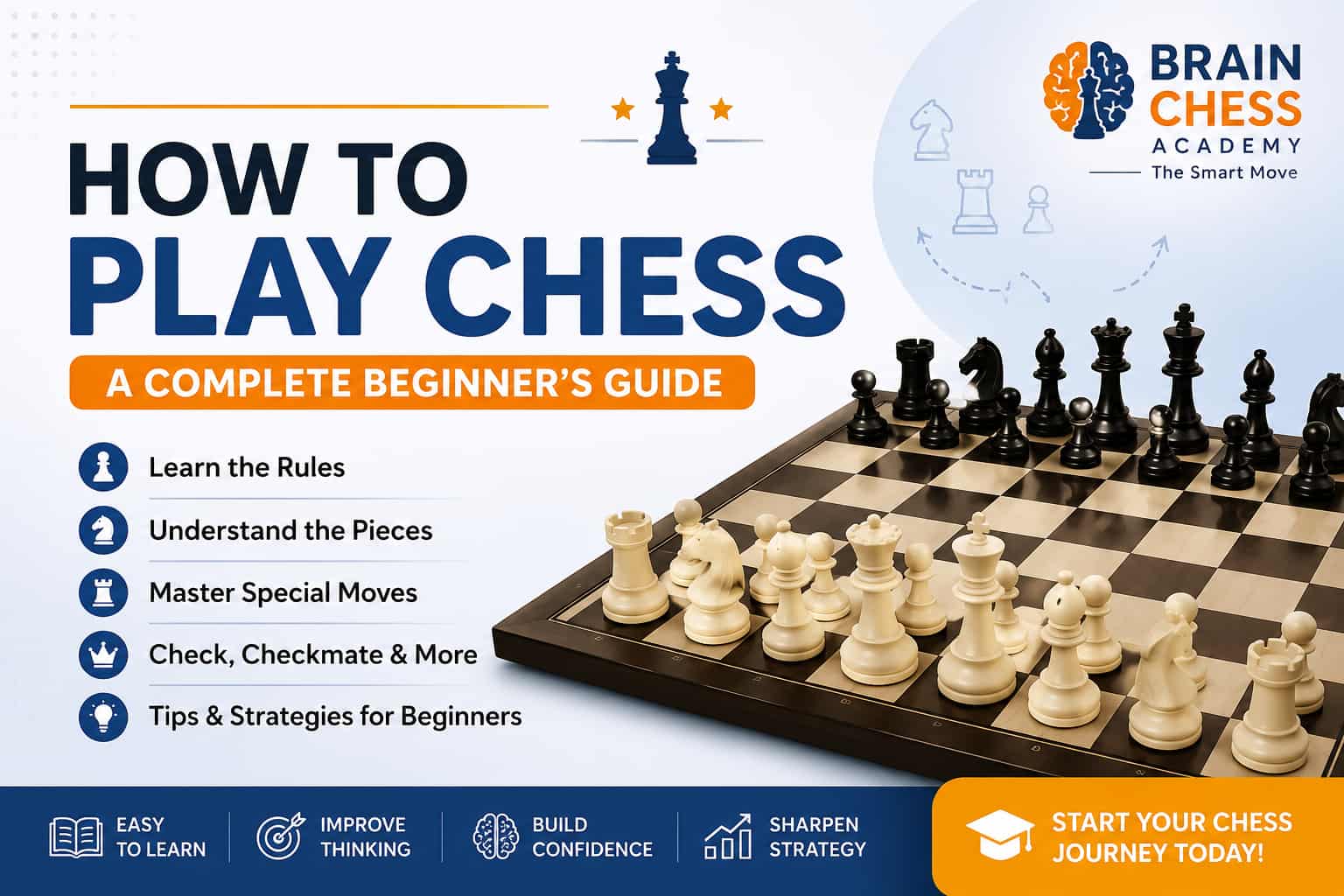
Chess is one of the world's most popular strategy games. It improves concentration, memory, logical thinking, and decision-making. Whether you're a child or an adult, learning chess is easier than you think.
In this guide, you'll learn the basics of chess in simple steps.
1. Chessboard Setup

Before starting, make sure the board is set up correctly.
✅ Bottom-right square should be white ("White on the Right").
Arrange the pieces as follows:
- 8 Pawns
- 2 Rooks
- 2 Knights
- 2 Bishops
- 1 Queen
- 1 King
Tip: The Queen always starts on her own colour.
2. Know Your Chess Pieces

| Piece | Value |
|---|---|
| Pawn | 1 |
| Knight | 3 |
| Bishop | 3 |
| Rook | 5 |
| Queen | 9 |
| King | Most Important |
3. How Each Piece Moves

King
- Moves one square in any direction.
Queen
- Moves any number of squares horizontally, vertically, or diagonally.
Rook
- Moves horizontally and vertically.
Bishop
- Moves diagonally.
Knight
- Moves in an "L" shape.
- Can jump over other pieces.
Pawn
- Moves one square forward.
- Moves two squares on its first move.
- Captures diagonally.
4. Special Chess Move
There are three special rules:
- Castling – Protects your king.
- Pawn Promotion – A pawn reaching the last rank becomes another piece, usually a queen.
- En Passant – A special pawn capture under specific conditions.
5. What is Check and Checkmate?
Check : The king is under attack and must escape.

Checkmate: The king is trapped with no legal move.
Checkmate wins the game.
6. Basic Chess Strategy
Follow these simple rules:
- Control the centre.
- Develop knights and bishops early.
- Castle quickly.
- Protect your pieces.
- Think before every move.
These habits help beginners avoid common mistakes.
7. Common Mistakes Beginners Make
Avoid these mistakes:
- Bringing the queen out too early.
- Forgetting king safety.
- Leaving pieces unprotected.
- Moving the same piece repeatedly.
- Ignoring your opponent's threats.
8. How to Improve Faster
Improve your chess by:
- Playing regularly.
- Solving chess puzzles.
- Analysing your games.
- Watching strong players.
- Learning from experienced coaches.
Even 20 minutes of daily practice can make a noticeable difference over time.
Why Choose Brain Chess Academy?
At Brain Chess Academy, we help students build strong chess fundamentals through structured lessons and expert coaching.
We offer:
- Online One-to-One Classes
- Small Group Coaching
- Beginner to Advanced Courses
- Tournament Preparation
- Game Analysis
- Weekly Practice
Whether you're just starting or aiming to compete, our coaches can guide you step by step.
Leave a Comment
Your email will not be published. All comments are moderated before appearing.