Elon Musk vs. Chess.com: Will AI Ever Fully “Solve” Chess?
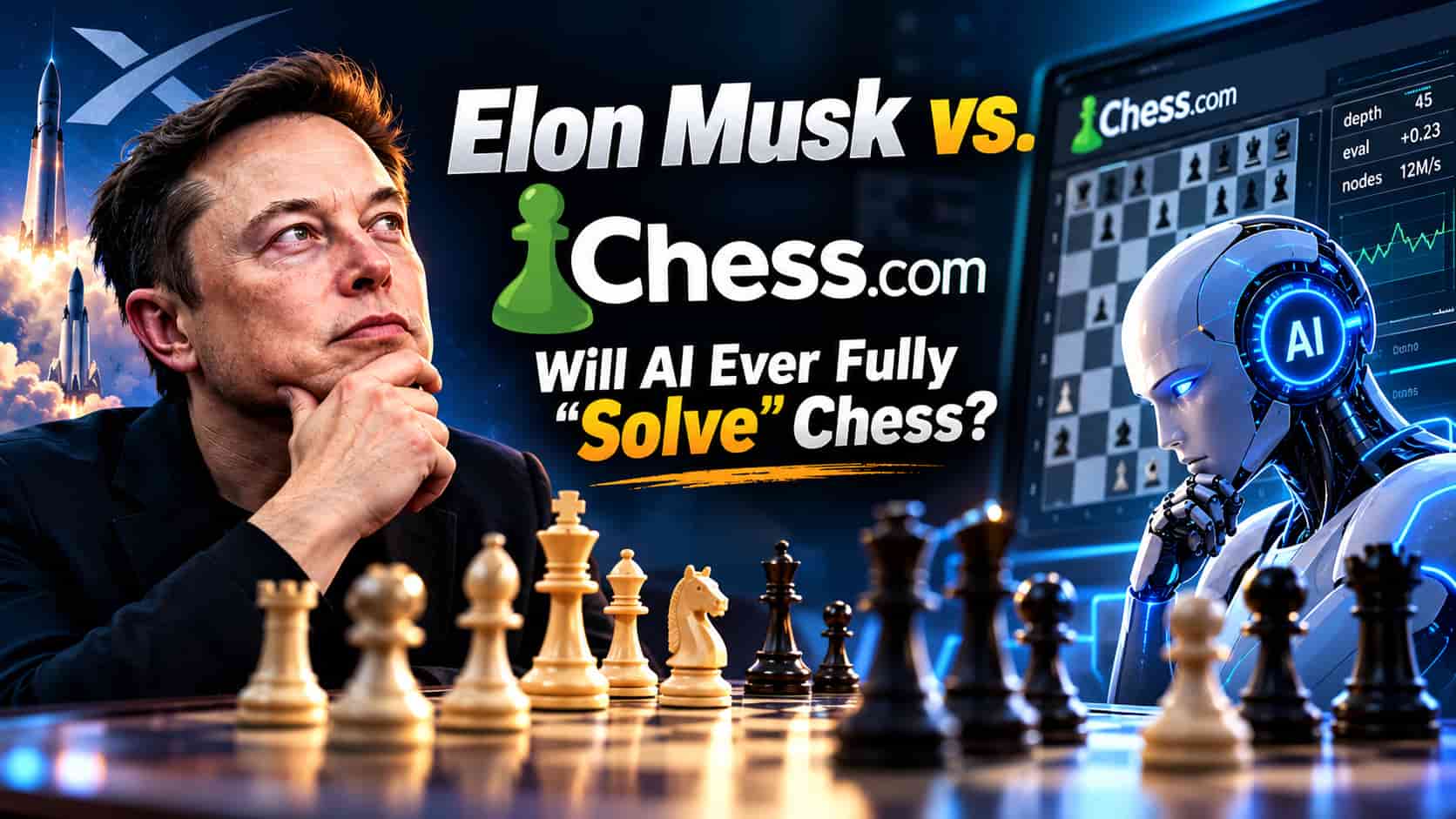
At Brain Chess Academy, we believe chess is a game of infinite beauty and complexity. But recently, the chess world was treated to a fascinating, and somewhat hilarious, debate: Can artificial intelligence (AI) ever fully “solve” chess? The clash? None other than Elon Musk, the world’s richest man, and the official Chess.com X (formerly Twitter) account.
The debate ignited on September 3rd when Musk posted on X that the number of chess moves that are not “utterly stupid” is actually very small, predicting that the game will eventually be fully solved. Chess.com, known for its witty online presence, fired back with a legendary two-word reply: “Skill issue.”
For the uninitiated, “skill issue” is gaming slang used to mock someone for losing due to a lack of ability. Musk, however, didn’t back down. He argued that while chess is undeniably hard for humans, it is not hard for computers. “One day, it will be fully solved like checkers,” Musk wrote, adding that people can still enjoy the game even if machines are vastly superior.

Chess.com quickly escalated the debate with hard math. The platform pointed out that the number of possible chess games is about 40 orders of magnitude (10^40 times) greater than the number of atoms in the observable universe. Mapping every single possibility, they argued, is a computational nightmare.
Musk countered by making a crucial distinction: the difference between possible games and legal chess positions. He argued that the total number of legal positions is vastly smaller than the number of atoms in the universe. His bet? Artificial Superintelligence (ASI) will eventually find ways to compress and solve this information far beyond current human imagination. As Business Insider noted, both sides actually have a point—they were just arguing about two different mathematical metrics.

Naturally, the intellectual debate soon devolved into classic internet banter. Musk jokingly called the person running the Chess.com account an “intern.” The account swiftly clarified they were a full-time employee, to which Musk replied with a single coughing emoji (🫁). Chess.com seized the moment, mocking Musk for replying so quickly that “even our friends don’t text us back that fast.” A Chess.com spokesperson later quipped, “We understand losing a chess game can be frustrating, but losing a Twitter fight to a so-called intern must be maddening.”

This isn’t the first time Musk and Chess.com have crossed paths. In 2022, Musk dismissed chess as “too simple” and not useful in real life, noting its 8x8 grid lacks a “fog of war,” technology trees, or random starting positions. Chess.com responded with an article playfully schooling him on special rules like en passant, castling, and pawn promotion.
Furthermore, Musk’s relationship with chess has evolved. In 2012, he famously shut down a Tesla employee chess tournament, stating the company “does not have time for chess.” Yet, 14 years later, he is deeply engaged in arguing about the game’s future. He even has skin in the AI chess game: in 2025, xAI’s Grok 4 model reached the final stage of a major AI chess competition, ultimately falling to OpenAI’s o3 model.

So, what does it actually mean to “solve” chess? In game theory, a game is solved only when the optimal result (win, loss, or draw) can be determined from every legal position, assuming perfect play. Checkers achieved this status after years of massive computational effort. Chess, however, remains firmly unsolved. Currently, only endgame positions with seven pieces or fewer have been completely mapped by tablebases. Solving the full 32-piece starting position remains a monumental, perhaps impossible, challenge.
At Brain Chess Academy, this debate is a wonderful reminder of why we love this game. Whether AI can eventually crack the code or not, the human journey of learning, strategizing, and growing through chess is irreplaceable. Machines may calculate, but humans create, adapt, and enjoy the beautiful struggle.
What do you think? Will AI solve chess in our lifetime, or is the game’s complexity forever beyond total comprehension? Let us know in the comments, and keep sharpening your skills with us at Brain Chess Academy!
Leave a Comment
Your email will not be published. All comments are moderated before appearing.